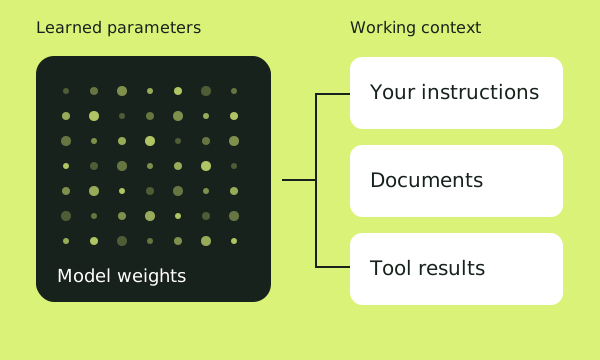
Giving an assistant a document changes the information available for that interaction. It does not, by itself, retrain the model. This distinction helps explain both the usefulness and the limits of prompts and skills.
Context is the working material
The context can include your instructions, conversation history, retrieved documents and tool results. The application decides what to send to the model. A context-window specification describes a capacity limit, not a promise that the model will reliably use every detail in a long conversation.
Weights are learned during training
A model’s weights are numerical parameters produced by training. Fine-tuning changes some or all of those parameters through an additional training process. Downloading weights lets compatible software load that model; it does not provide the compute needed to run it.
Retrieval brings relevant information into context
A retrieval system searches an external collection and places selected passages in the model’s working context. This can keep answers grounded in your documents without updating the weights. The quality of retrieval, the freshness of the documents and the model’s use of evidence all matter.
Skills help structure the work
A skill can tell an agent which information to gather, what steps to follow and how to check a result. Its instructions can improve consistency, but they do not replace model training or make inaccurate source material correct.
Check the deployment requirements
For an open-weight model, check the architecture, file format, quantization and hardware requirements. Model size alone is not a complete memory estimate. For a hosted service, check the provider’s limits, data handling and pricing. Dave AI’s model section is prepared for these facts; it does not host model weights or run inference.